
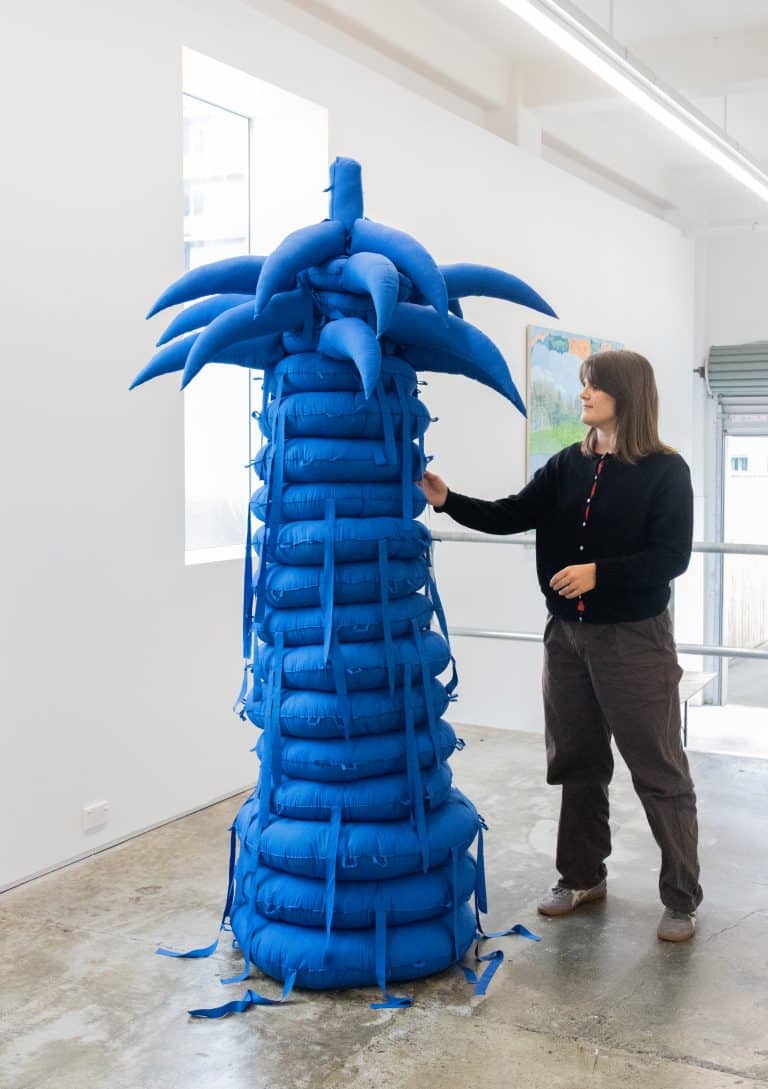
Five months in, and PEG Gallery already feels like it's been on Cuba Street forever. That's a credit to Peggy Robinson, who opened the space in November last year with a clarity of vision that reflects her character, and deep respect for the humans she works with. Rooted in artists' advocacy and genuine partnership, and reflecting a kaupapa Māori framework that shapes everything from programming to the day-to-day, PEG has become one of the most exciting contemporary art spaces in the nation. We caught up with Peggy on the opening day of the gallery's current exhibition, Civic Weeds, to talk about what the first chapter has looked like from the inside.
I'm Peggy Robinson. I was born in Ōtautahi, studied in Tāmaki Makaurau, and moved to Pōneke about nine years ago. I'd spent a lot of time in artist-run spaces and knew I wanted to be working in galleries. Landing a position at Page Galleries shortly after moving here was a real turning point. I had a lot of freedom to programme and bring in new voices. It lit a fire.
I think of myself primarily as a gallerist. Curation is a hat I put on sometimes, not one I wear all the time. What I do feels more like facilitation - supporting artists through application support, letters of support, helping develop new ideas, writing text, being a sounding board. There's a lot more to it than just showing work.
I still kind of have to pinch myself that we managed to find a spot on Cuba Street. When I first started looking I just put it in the impossible basket - surely all the good spaces would be too expensive or already occupied. When I found this one it was really exciting, particularly the way it's set back off the street.
You're so connected to Cuba Street and its history and creative energy, but you still have this ability to create a little haven back here. It's a real dream space. And being in the heart of this city has been super informative as to what I want the picture of a gallery space to look like - how it could operate, particularly in the dealer-gallery world here.
In Pōneke, there's a fractionally slower pace of life and this real community way of operating is embedded into the core of the city. I've had so much beautiful support from other spaces, they're just stoked for me, for the community, for the whole sector. The more spaces the better for everyone.
A lot of it is just the fundamentals of operating a space. The foundation versus figurehead thing is really about not centering myself too much, recognising my own biases and that I kind of unintentionally position myself as a leader by doing this. But what that support looks like isn't about being a tastemaker or proving myself. I really try to have genuine relationships with my artists and listen to what they need from me.

It can look like picking up an artist from the airport, jumping on a Zoom with a cohort of artists working towards an exhibition later in the year to touch base and talk through ideas. I've recently joined the Enjoy board, so my week can look like supporting Tendai and his directorship there. It can look like supporting artist Turumeke Harrington (artist/friend) - she's just moved her studio to Lyttelton - lots of artist relationship things. Writing artist bios, being an editing eye, and talking with visitors when they come in. You get collectors who want to talk about work, artists who want to chat about their practice or just vent about something. I don't mind, I'm just an ear for all different things. The branches of this work are really diverse. It can be overwhelming sometimes, but it's also equally rewarding because you get to be present and responsive to the needs of the people you’re working with.
Definitely just the enthusiasm. While I was slowly cooking this idea and inviting artists to be a part of it before it was public, within a close nexus of dearest mates, there was a lot of enthusiasm then too. It's kind of their obligation to be supportive of what you're doing, so it’s been special having complete strangers who've come in and been genuinely thankful for a new art space opening in Wellington.
I opened the space just before the regional library came back, and caught all these people in a moment where third spaces felt needed. People here are so ready for good news, so it's been this quite amazing, really immediate connection with a lot of people, which has been super special.
I think of being totally open at all times for learning and changing and growing. I'm Pākehā and I'm very conscious of what it means to operate a Pākehā space while genuinely supporting the vitality of toi Māori and honouring what a tangata Tiriti relationship looks like for me in this space.
A lot of it has to do with language, thinking about some of the language that's been used in dealer spaces for a really long time, like the idea of artist stables, which positions artists almost as trophies instead of partners. Trying to have really authentic partnerships with each individual artist, and using words that actually better articulate what those partnerships look like. There's also a lot of opacity in the arts, and I'm really into being transparent. I'm eager to always be working on and growing relationships, with artists, with the community and with Mana Whenua, honouring this place and its people.
If someone comes in and wants to know how you even get into a gallery space, what representation looks like, I'm game to share everything I know. Then there are smaller things, thinking about how work is cared for when it's in the space, how you honour it. Trying to clear the space before people come in, whether that's with a short waiata or karakia. Just that slowing down and giving a little grace to everything that's happening here.
It's a really fun challenge and I love the model of a group show, it creates a network between artists and dialogue, and you get this lovely cross-section of audience where each individual artist's community comes around and it's a time that’s really ripe for discovering new practices.
All of the artists of Civic Weeds, in their own way, make work that responds to urbanism and being in city spaces. And urbanism is a perfect example of something that produces such a diverse range of outcomes because everyone's moving through the city, dealing with their own stuff in their own way. The biggest fear with a group show is always that works might detract from each other if you're not placing them with care, you have to make sure there’s time to really ruminate on how the works will talk to each other.
I think both, honestly. I grew up in Christchurch and was there for the earthquakes, so I have this really visceral experience of that, so many decrepit, honestly depressing corners of a city, but watching these really fruitful new things grow at the same time, and the way those two things simmer alongside each other.
Being here in Pōneke right now, you have a council trying to develop parts of the city, empty lots, and then bang, the new library opens and it's all shiny and new and exciting. There's a lot of joy to be had in moving through our city but you definitely come up against the other side of it too. I think that tension is alive for a lot of people at the moment, and all of these artists are responding to it in ways that feel really alive and urgent rather than theoretical.
It feels like a really awesome time for young independent business here.
Hannah at Sully's has such an amazing vision for that space and is just one of the coolest people in Wellington.
Coffee Outdoors, I used to be a tramper and work in a specialty outdoor store so there's a real converging pathway there for me, I could so imagine doing what they're doing.
Margot in Newtown is a favourite, I live in Newtown so that one's close to my heart.
Rasa Malaysian always has good energy, it's always full of people having a lovely time.
Outside of the city centre, Bikaner on Jackson Street in Petone. Quite possibly the best Indian restaurant in the region. We often do a pilgrimage out to Petone to go to the Dowse, and then go there. It's a good combo.
And a huge shoutout to Maxine at Underlena!
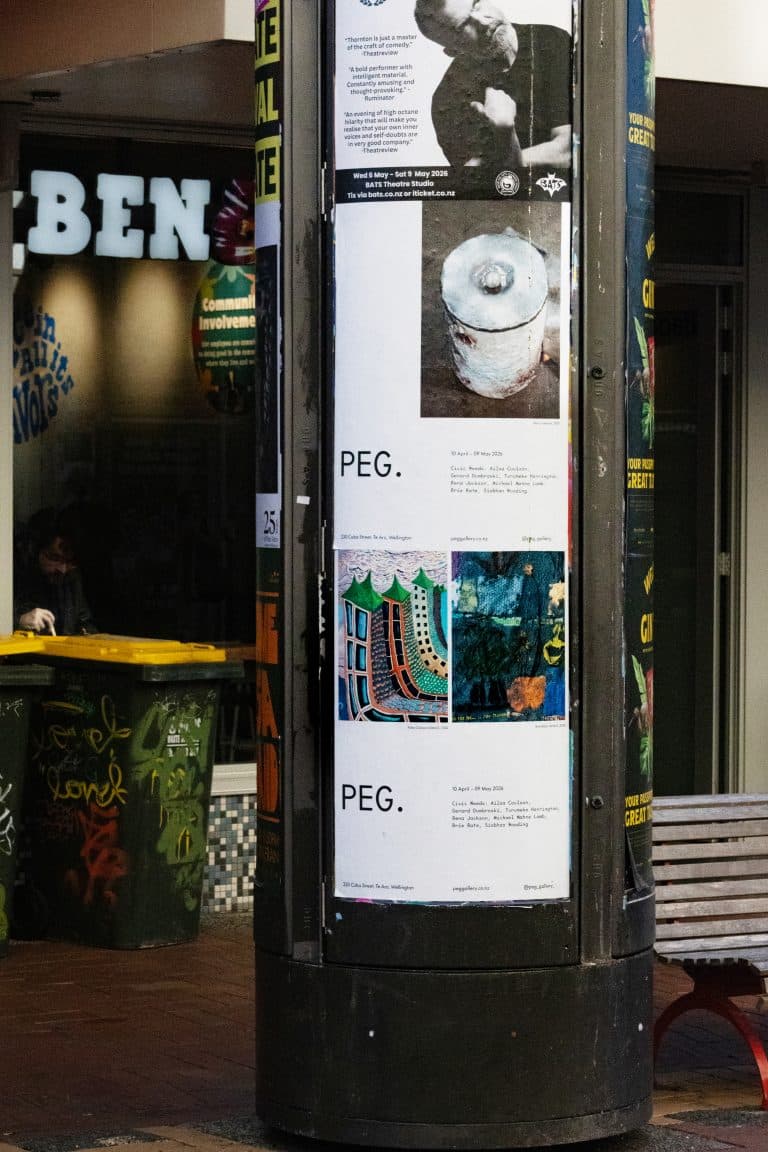
'Civic Weeds', a group exhibition by Ailsa Coulson, Gerard Dombroski, Turumeke Harrington, Bena Jackson, Michael Mahne Lamb, Brie Rate, Siobhan Wooding runs 10 April - 09 May at PEG Gallery, 230 Cuba Street.
© 2026 Phantom Billstickers. All Rights Reserved | Privacy Policy | Terms & Conditions | Web Design by Virtual Innovation
