
Digital marketing has changed how businesses reach people. Social media, search ads, email, influencer partnerships: there are more channels than ever to get in front of an audience. But there's a catch. The easier it gets to advertise online, the harder it is to be believed. People scroll past hundreds of ads a day and have seen enough scams, fake reviews, and AI-generated filler to be wary of anything that only shows up on a screen. The harder part now isn't getting noticed, it's being believed once you are.
Phantom Billstickers has spent more than four decades putting brands on real walls in real places, since 1982. A street poster can't be skipped or closed out of. It sits on the street, doing its job.
Every app, feed, and streaming platform is fighting for the same attention. People are also more clued up about data privacy, clickbait, and fake websites than they were five years ago, and it shows in how carefully they vet a brand before buying.
One good ad isn't enough anymore. Real confidence takes more than a single online touchpoint. It takes showing up consistently in the places customers already are.
A street poster can't be swiped away. It sits on a wall or in a frame where everyone walking past can see it, day after day.
A well-designed poster in a busy spot tells people a business has put in the effort to reach them, not just run a few ads from a laptop. A single poster won't close a sale by itself. It adds weight to the impression that a business is established.
Marketers have known for decades that people trust what they recognise. Someone walking the same route to work, catching the same train, or wandering through the same shopping strip passes a poster again and again without even trying. That repetition does the work on its own.
It carries over into how people respond online, too. When that same person later spots a brand on Instagram or in a Google search, it already feels familiar.
Out-of-home advertising reaches people without asking for their attention first. Phantom's network puts posters where people already are: busy shopping strips, entertainment precincts, city centres, university areas, and high-footfall pedestrian streets.
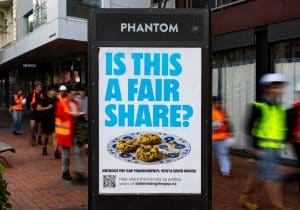
Barker's of Geraldine built on exactly this when it launched its Squeezy Fruit Preserves range. Phantom built a custom activation opposite Woolworths Ponsonby, pairing a street poster site with live sampling on the ground. Over 1,500 samples went out in five days, lifting sales across grocery banners. Nobody had to click anything. They just walked past, took a sample, and remembered the brand.
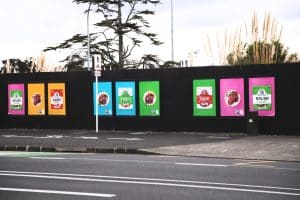
The strongest campaigns rarely lean on one channel alone. A poster earns the first moment of attention, but a QR code, hashtag, or short link is what turns that attention into a next step: a website visit, a follow, or an enquiry.
Garage Project's Tiny takeover shows how that plays out. Phantom built a Christchurch site around the brand's push toward the GABS Hottest 100 Kiwi Craft Beer competition, backed by real social buzz that carried the campaign past the people who physically walked past the wall. Tiny placed third, the first non-alcoholic beer to podium in the competition's history. That's why Phantom builds a digital call to action into poster designs from the start rather than treating it as an afterthought.
For a business that lives in one town, city, or region, showing up locally matters more than showing up everywhere. Posters let a brand sit inside the community it's actually trying to reach.
Phantom's nationwide network runs the length of the country, but campaigns can be narrowed down to specific suburbs and streets. We also run dedicated Arts + Events bollard networks in Wellington and Christchurch, built specifically for festivals, live music, theatre, and community events. Local campaigns tend to work especially well for festivals, retail openings, hospitality venues, and community initiatives.
Automated online ad placement can put a brand next to content that has nothing to do with its values. That's a real concern for a lot of marketers right now.
With Phantom, brands know exactly where a campaign is going up. Our proprietary booking system guarantees placement and gives time-stamped proof the moment it happens. There's no algorithm deciding where a brand ends up.
Digital campaigns tend to get judged on clicks and conversions. Awareness campaigns need a wider lens. A strong street poster advertising campaign can move the needle on brand recognition and recall, local awareness, branded search volume, and QR code scans, without requiring anyone to act the second they walk past.